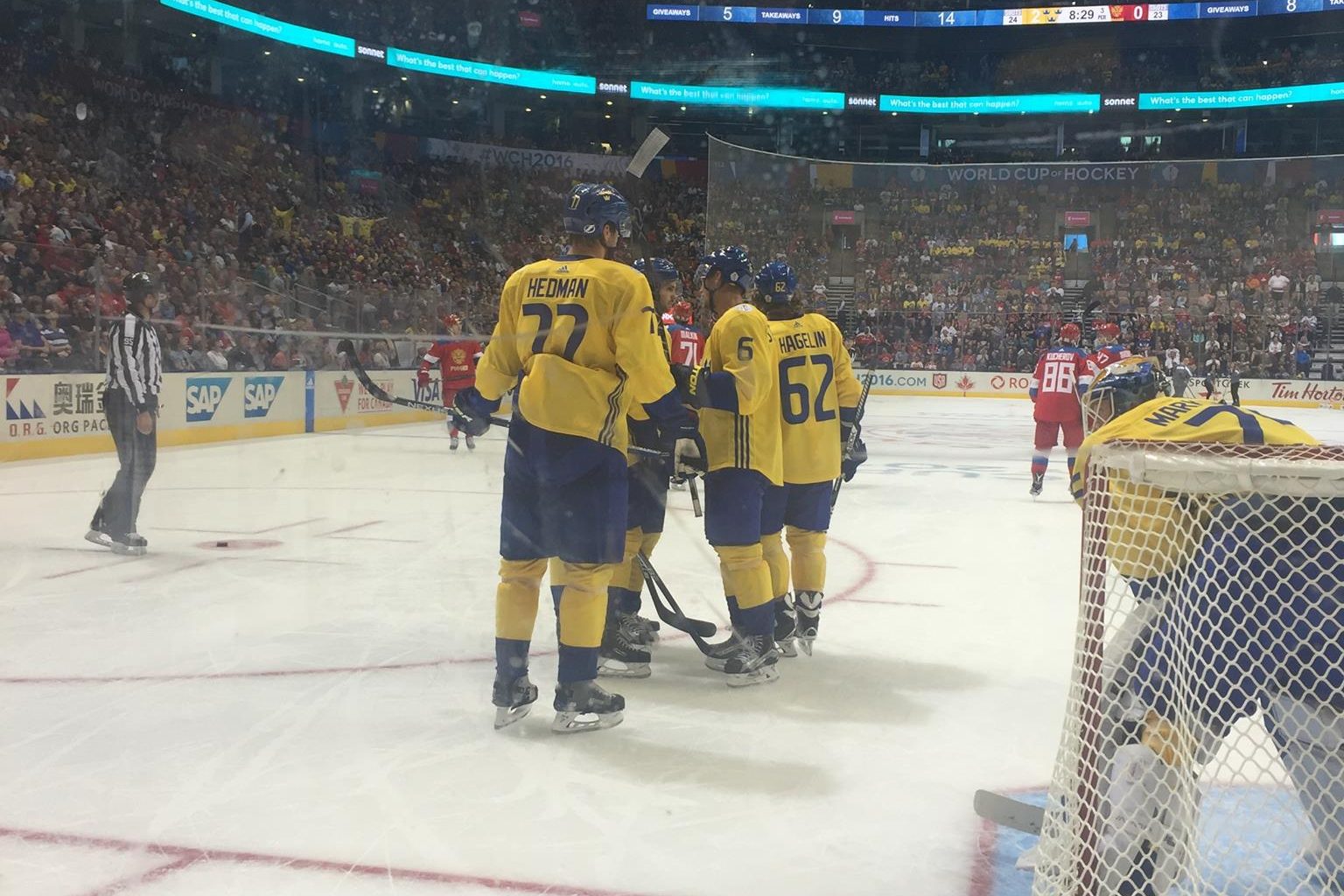
Every discussion of hockey stats I have with my dad always comes back to Plus-Minus. While we both know what the rest of the world knows (Plus-Minus is a terrible gauge for a player’s overall success) we still think there’s something to a stat like that. After all, to win you have to score more than the other team. A player’s ultimate value rests in their ability to help their team do that. Fraternal twin cousins of the Plus-Minus statistic are total goals for (TGF) and total goals against (TGA). As their names may imply, these are the goals scored whenever a player is on the ice, be it 3-on-3, 5-on-3, Power Play or Penalty Kill. What is not tracked is TGF minus TGA. Here is where I present, for the first time ever in North America, (and probably the world) the Hockey Stat (HS). The formula for calculating HS:
TGF-TGA= Hockey Stat (HS)

What’s special about the Hockey Stat is:
- It’s different from a player’s plus-minus
- There is a ridiculously high correlation between a team’s points and HS
Difference between HS and Plus-Minus (PM)
To demonstrate the difference between a player’s PM and HS, let’s look at the 2014-2015 Chicago Blackhawks as an example.

As you can see, no player’s HS and PM stats are identical. In fact, Andrew Shaw and Patrick Sharp (among others) change from negative to positive players. This change can be attributed to the fact that both played on the Blackhawk PowerPlay. The goals scored while on the PowerPlay are not included in PM, but those goals get factored into the HS. Marcus Kruger (a personal favorite player) is treated more unkindly by HS because he was a staple to the Blackhawks Penalty Kill.
Correlation between HS and Team Points
When the HS is summed for all players on a team there is a ridiculously high correlation between the HS and wins. Below is the output from our analysis. It shows the correlation to team points for PM, expected plus-minu (E+/-), Goals for (G), and HS. It also includes the correlation coefficient for each of those stats from one season to the next (YR+1).

HS has the highest correlation to winning of any of these stats, all of which are the highest correlated to wins. and compare that to the number of wins for the team. And each stat with the exception of goals and HS fall flat when correlated from one season to the next. This is an important attribute of a statistic because a good stat needs to be consistent and what good is it if you can’t evaluate a player from one year to the next.
Problems with HS
We understand that no stat is perfect and HS is no exception. When we ran an analysis of HS from all NHL players in the 2018-2019 season we unsurprisingly found three Lightning (Stamkos, Kucherov, and Hedman) in the top 4 players. That team was dominant and all three played on their D-Y-N-O-MITE PowerPlay. Our next order of business with HS is to factor it by the strength of the team a player plays for. Check back later for that analysis.
 GPAnalytics